Wednesday, December 14, 2011

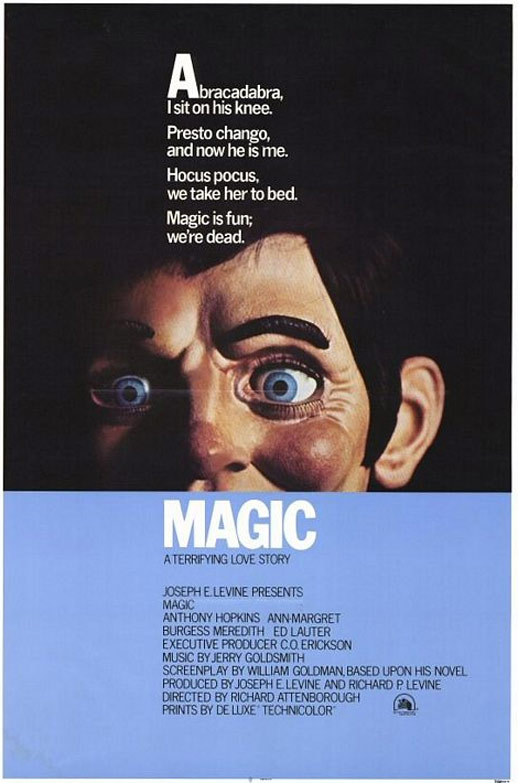
Magic


1978 was a great year for the horror film: Halloween, Dawn of the Dead, just to name a couple of the big hitters.

But the horror film from '78 I find myself returning to most often is Richard Attenborough's unhinged and certifiable Magic.

Magic was a big studio film directed by a very well regarded and established filmmaker who was better known for his acting gigs in movies like The Great Escape, Seance on a Wet Afternoon, The Flight of the Phoenix, among others.

Magic also starred Anthony Hopkins as ventriloquist Corky Withers who is controlled by his dummy Fats. Burgess Meredith plays Ben Greene, Corky's concerned manager, who tries to convince Corky to take some time away from Fats. Corky, however, needs to make a living and Fats is his money-maker. But, the truth is, Corky can't stop being Fats and Fats is actually Corky uncorked.

Fats does anything he can to keep Corky from making friends. He especially doesn't want Corky to fall in love, which he does anyway - to Peggy Ann Snow (Ann-Margret, you know, the infamous "Kitten with a Whip"). Peggy Ann is a threat to Fats but there's really not much she can do about Fats - er, Corky - anyway.

Attenborough and writer William Goldman (Butch Cassidy and the Sundance Kid) weave an intense, psychologically complex thriller that's unpredictable, perverse and creepy.

And the little ditty floating above Fats' head in the poster is marketing brilliance. It tells you everything and nothing:

Abracadabra,
I sit on his knee.

Presto chango,
and now he is me.

Hocus pocus,
We take her to bed.

Magic is fun;
We're dead.

Saturday, December 10, 2011

Hey Santa! Butt me!


This is going to be my last Christmas post for 2011. But you gotta hand it to Lucky Strike for their marketing cajones.

Does UPA's Frosty the Snowman = Creepy?

Okay, so I kinda Grinched myself when I recently tweeted that the clip below was "creepy."

But that doesn't mean its bad. Its jaunty, jazzy and of its time. It was produced in 1954 by UPA Studios and became a Chicago-area Christmas staple. Kids growing up during the 1960s and 1970s saw this thing a lot if they watched a morning show on WGN-TV called Ray Rayner and His Friends. Anyway, its a piece of nostalgic charm that's probably lost on anyone born after 1980.

Even if it is a little creepy...


Friday, December 9, 2011

Xmas


I find this film uninspired and the characters unappealing. But the poster has a way of embracing the season and I do appreciate that.

Plus I have a warm spot for this:


Wednesday, December 7, 2011

God Forgives...I Don't


One of my favorite lines in Robert Rodriguez's certifiably insane Machete is when Cheech Marin says, while pointing a gun at the head of a man begging for his life, "God has mercy...I don't."

A fantastically blasphemous statement punctuated by Marin pulling the trigger and blowing the man's brains out. What's better is that Marin plays a priest, so what he says, while not subtle, is hysterically offensive.

Machete began as a faux trailer in the Rodriguez/Tarantino film Grindhouse and Rodriguez developed it into a feature film that easily could have played second or third tier at some drive-in back in the 1970s.

What I recently learned was that the Marin statement actually spins off from an Italian film from 1967 called Dio Pardona...lo no! The American release was renamed Blood River, possibly because the distributors were nervous about the actual translation - God Forgives...I Don't!

The film stars Terence Hill who plays a character named Cat Stevens. Hill goes on to play this character in two other films: Ace High (1968) and Boot Hill (1969). These films also star Bud Spencer.

Terence Hill and Bud Spencer may not be known here in the States now but - believe it or not - in the early 1970s, they actually got some play and kids that hung out at Saturday or Sunday afternoon matinees during this time probably remember them.

Hill and Spencer paired up for a double shot of spaghetti western mayhem in My Name is Trinity (1970) and Trinity is STILL My Name (1971). My father took me to see both of them when I was really young. He must have liked My Name is Trinity because it wasn't long after seeing it that he hauled me to see the sequel.

I haven't seen either one since they came out but I do remember snippets. I remember Trinity riding into town, laying on a make-shift wooden sled pulled by his horse. Hill played Trinity so laid back that the character simply oozed charismatic obstinance. He was the perfect character for a generation trying to adopt a "What, me worry?" attitude despite the Vietnam War, campus violence, skyrocketing inflation, the gas crunch - all raging in life's background.

What's changed since then? Besides Vietnam, that is. The truth is we need Trinity now more than ever.


Friday, December 2, 2011

Pulp Fiction


"A book containing lurid subject matter, and being characteristically printed on rough, unfinished paper."

Vincent: I think we should be leaving now.

Jules: Yeah, that's probably a good idea.

Wednesday, November 23, 2011

Kitten with a Whip


If you've never seen Ann-Margret in her early 1960s prime, then you probably can't imagine the concept behind the "sex kitten," a sexist, condescending term that, back in the day (possibly coined in the late 1950s and, again possibly, attributed in 1958 in reference to french actress Brigitte Bardot), meant "hottie."

In the early 1960s these up and coming "sex kittens" (Bardot, Raquel Welch, etc.) - while splashed all over movie fanzines - didn't carry the extra burden of being exposed and defined by their proclivities, i.e., rampant sexcapades, drug-fueled frenzies or shoplifting rampages a la Lindsey Lohan.

Ann-Margret, who went to New Trier High School in Winnetka, Illinois and attended Northwestern University, started to gain notice shortly after the death of Marilyn Monroe in 1962. In her career, Monroe had defined the concept of "bombshell," ultimately inspiring the looks of such B-graders as Mamie Van Doren and Jayne Mansfield. Ann-Margret, on the other hand, was something completely different - thinner, red hair - someone who purred sex and meant it, as opposed to Marilyn Monroe, who played her roles alluring (at that time, anyway) with an aware unawareness of self.

Ann-Margret's first film - A Pocketful of Miracles - came out in 1961 and was a tame, non-threatening effort - a family affair. In '62 she was in State Fair with boring, clean cut Pat Boone. In '63, she started to define herself in Bye Bye Birdie but it was her role as Rusty Martin in Viva Las Vegas (1964) that exploited her physical attributes with her "sex kitten" coquettishness playing alongside Elvis Presley, who was reaching his apex. Yet Ann-Margret was still blooming wholesomeness - someone you could easily bring home to mother.

That is until her next movie (released the same year as Viva Las Vegas), Kitten with a Whip. Even in 1964, the title alluded to something vaguely sadomasochistic, something you might see on 42nd Street.

Despite the film's S&M title, the movie is actually an obscure juvenile deliquent romp, with Ann-Margret playing head JD and juvie detention hall escapee, Jody Dvorak. Now the clean-cut "sex kitten" is implied to carry a whip (which Jody does not in this movie), making things a little naughtier.

About Ann-Margret's performance in Kitten with a WhipShock Cinema editor Steven Puchalski says, "Lemme tell you, this flick is without a doubt the finest showcase of Ann-Margret's talents. She's a tough, no-nonsense bitch, using sex 'n' a smile to get what she wants, and this harder edge makes her more alluring than ever. When she snarls and brandishes the broken end of a whiskey bottle --- well, I think I'm in love."

Tuesday, November 22, 2011

He lives on skis...


In 1979 I learned how to ski at a small place called Majestic Mountain located off Illinois Route 47 just over the Wisconsin border right outside of Lake Geneva.

I learned to ski there on cheap rental equipment and less than $10 got you an all day ski pass from 10:00 a.m. - 10:00 p.m.

This place fueled my dreams (though short-lived) to chuck family, friends, college to become that dreaded societal pariah...the SKI BUM.

Majestic's long gone but here's some footage of what remains of that formative ski hill:


Wisconsin Footage 1 from Mike Kwielford on Vimeo.

Sunday, November 20, 2011

Wait


There was a time when people were allowed to smoke in movie theaters. There were actually smoking sections but smoke would still pervade throughout the theater. Its amazing the power big tobacco and rude smokers wielded over us unfortunates who didn't find taking the gamble - with lung cancer, emphysema, stench, premature wrinkles, destruction of brain cells, lung capacity, loss of memory, inability to partake in long walks, inability to run or do anything remotely athletic, inability to rationalize logically, and so much more - worth the nothingness you get in return for lighting up.

On the initial run of Wait Until Dark in 1967, during the final eight minutes of the film, theaters would shut down all extraneous lighting (including Exit lights), plunging the audience into complete darkness save for what was playing out on the screen. This little novelty worked - viewers became completely immersed in the world of a blind woman (Audrey Hepburn) being terrorized by psychopathic thugs led by Alan Arkin.

Funny. This poster for Wait Until Dark makes a politely pandering plea to smokers asking them to refrain from "lighting up" during this sequence as doing so will break the spell of the movie.

Who says B-movies don't have an agenda?


Larry Cohen's It's Alive is a blatant metaphor for hatred and fear of kids and, if it wasn't so hilarious in it's badness, the film's politics would be downright scary.

It's Alive played the drive-in circuit for years after initially released in 1974 and spawned (unintentional pun intended) queasy sequels: It Lives Again (1978) and Island of the Alive (1987) and it was remade in 2008.

Monster babies? So what? Monster or not, get rid of 'em all. It isn't by chance that Cohen shows a close-up of printing on the back of an ice cream truck that says, "Stop...Children."

Saturday, November 19, 2011

Alien invasion


It happens every year at the same time. Mid-November I get so sick it knocks me "out of the box." I feel it come on slowly, first in the lungs and throat, then it disappears for about a day, fooling me into thinking I somehow beat it. Then it comes on full force evolving into a debilitating sinus infection that impacts my whole being body and soul.

This year I was smart and instead of "riding it out" for days as it tightens its grip, I went to a doctor immediately and was - happily - prescribed the proper medication, shortening (somewhat) its intensity.

Last year I battled a week's worth of pain and suffering that led to an inability to physically remove myself from bed. I forced myself to the doctor on the fifth or sixth day, received antibiotics, which kicked it out in short order.

This year, I received antibiotics quickly, the suffering wasn't as deadly-seeming and I only missed a couple days of work, with final stages ebbing over the weekend.

I'll be right as rain come Monday, happily bounding to the workplace knowing full well I'll be able to enjoy a long Thanksgiving holiday healthy and wise.

So why The War of the Worlds? Because I think the aliens were invaded by an alien (to them) infection not unlike my annual bout that eventually killed them at the film's forehead-slapping conclusion (I'm talking the 1953, Byron Haskin directed film).

Sunday, November 13, 2011

This is this...


On a sickbed (nasty cold) and on leave from a family gathering (not wanting to spread germs), I decided to revisit Michael Cimino's only masterwork, 1978's The Deer Hunter. I've had a love/hate relationship with this film since first seeing it when it was released.

I was still in high school when I saw it the first time and, in fact, saw it twice in '78. The first time I saw it with a friend and the decision to see it was based on my recommendation as I had probably read a review about the film and knew it was not to be missed. A couple things I remember about seeing it then - neither of us realized how long the movie was. We went to a 9:00 p.m. screening on a - God forbid - school night. I wasn't under the hammer of strict parents and curfew but my friend John was. I remember him whispering at around the two hour mark (about 11:00 p.m.), that he was dead. But I was the driver and I wasn't about to leave. By the time it ended, just after midnight, John ran out of the theater to get to the car fast - as if that was going to make up being late. We still had a about a half hour drive home ahead of us. And that drive home was in complete silence.

And, while John may have been fearing the wrath of his parents, I think the silence was due to the film. At 17, I couldn't fully grasp the establishing first hour (what was that all about, I wondered), the second hour was unbearably tense and the final hour unbearably sad. Probably 95% of the film's symbolism and flash forwarding was lost on me on a conscious level. But something happened subconsciously.

I saw the film with another friend a couple weeks later and this time I eased into it's flow and time frame. The film's three-part structure made more sense and I realized that the conclusion of the film wouldn't have had the same power had not the establishing first hour happened. Simply, I needed that second viewing to come to terms with it. And the friend I saw it with - Larry - got it immediately. He had also been writing a paper on Vietnam for a class so the film provided a humanistic framework for his research. John, on the other hand, got in trouble at home and that overshadowed his experience with the movie. He never wanted to talk about it.

When I saw the film on videotape 10 or so years later I was disappointed. The image (though I now know why) was washed out, small, chopped, and crushed. Because it was panned and scanned, its vistas were lost, main characters in the margins of the screen were missing. It was like watching half the film but in its three hour time frame. I was depressed by it and found it completely unbelievable.

In the early days of DVD, I watched it again and saw its power but strugged with character believabilty. I also had a problem with the "God Bless America" ending and wrestled with its meaning. Directorial irony? Too forced. Reality? Possibly. Maybe the characters would do this and mean it on a literal level but I don't know if they were capable of irony except possibly for Michael, a character who undergoes phenomenal change by the end of the film. But I don't know that Michael would do this because, by the film's conclusion, he is a fully internalized man.

So with this recent viewing, I didn't try to find all of its subtext. And this time I believed these characters would act how they did. I believed in the environment on all fronts - home pre-Vietnam, Vietnam and home post-Vietnam. I believed Nick would end up where he did and I believed Michael would have kept his word to Nick even though he failed.

And, shedding the struggle to find deeper meaning, I even believed the "God Bess America" finality.

Monday, November 7, 2011

Cinderella Liberty


When I first saw this particular poster for Cinderella Liberty, I didn't know what the film's name really meant (leave time for a soldier/sailor that starts at revielle and ends at midnight). Or that the girl in the photo was a hooker.

What I also failed to see - at age 13 - was the street James Caan and Marsha Mason are walking along. Its gritty, dirty; it's Deuce-like (New York City's infamous 1960s/1970s Times Square area was called the Deuce. Cinderella Liberty was filmed in Seattle and most big cities during that time had similar Deuce-like environs) string of theaters. The theater marquees behind Caan and Mason advertise illicit movies. At age 13, I missed all that - at least overtly - but that stuff wormed its way into my unconscious mind.

Another poster for the film included this (which barely resonates on any kind of psychological level):

She's 32.
She drinks too much.
She hustles pool.
She's got a 10-year-old mulatto son.
She's got a different boyfriend every night.
She's in trouble.

And he's in love.

It simply says too much.

I've never seen the film, directed by Mark Rydell and released in 1973. I've only seen clips. I've always had the feeling that this is one of those movies probably best lived in a long ago adolescent mind.

Says Roger Ebert, Cinderella Liberty "wants us to take these people and their situation seriously, but it keeps finding Norman Rockwell solutions to its problems. It suggests complexities and then never resolves them. It never surprises us with truth."

But the poster is great.

Saturday, November 5, 2011

Drivin' hard...Ridin' easy


Back in 1974 I wanted to be Larry Rayder from the film Dirty Mary Crazy Larry.

I thought Peter Fonda was the coolest actor in the world. Since his role as Wyatt in Easy Rider, nobody had a handle on laid-back counter-culture cool like Fonda. Before Easy Rider in 1968, Fonda had already starred in countless TV shows and movies. Once Easy Rider hit, he became the unofficial spokesperson for a generation already embracing anti-authoritarian psychedelia, acid-rock, and movies far from the Hollywood fray. Fonda's movies "spoke" to youth tired of being force-fed the hypocritical trappings of their parents. His connection to 1960s kids only strengthened once Easy Rider took hold.

Shortly after Easy Rider, Fonda directed an obscure, elegiac, Western called The Hired Hand, which, like Monte Hellman's early 70s oaters, was anti-Western, opposing the tired Hollywood take on the wild west favoring, instead, deep character study.

But it wasn't long before Fonda moved into action-movie mode (around 1974). And it was during this phase that I started to watch the actor more intently. With Dirty Mary Crazy Larry, Fonda advanced his anti-authoritarian disposition that appealed to kids at my age. I found myself attempting to adopt Fonda's onscreen persona. I tried to be laid back, not easily flustered, cool with the chicks - all with a slight chip on my shoulder. But, at the age of 14, which was how old I was when I first saw Dirty Mary Crazy Larry, I failed at all of these things. The one thing I could handle at that age was Fonda's style of dress - jeans, boots, denim shirts, aviator style sunglasses, etc. But again, for me at 14, this 'look' struggled to fly.

Dirty Mary Crazy Larry became my La Dolce Vita (supposedly the film Roger Ebert dreamed of emulating). I wanted to run the countryside as an outlaw in a Dodge Charger with a girl like Mary (Susan George) by my side.

But at 14, without a driver's license or the attention of a chick like Susan George, this never happened.

Tuesday, November 1, 2011

Sensory deprivation


In 1987 I paid $50 to spend a hour in a sensory deprivation tank (aka "floatation tank," "isolation tank") at a tank spa in Chicago called "Space Time Tanks." The marketing pitch for tank floating was that you will experience a "reduction in tension," "an increased ability to visualize, create, imagine and problem solve," "super-learning by increasing the mind's powers of retention, comprehension and original thinking," and "peak performance enhancement."

The mood was set at "Space Time Tanks" as soon as you entered the tiny lobby, which floated with strawberry incense while the clerk was wearing tie dye, sporting flaxen hair and exuded a very hippy vibe. She was pleasant in that girly stoney way, handed you a couple of plush towels and led you to your tank room. The room was small with a coffin shaped metal box in its center and a shower in the corner. The rule was you had to take a shower before entering the tank. And you went into the tank nude.

The tank itself was white and had a portal-like door that you opened to crawl through a hole that led to brackish water that was filled with epsom salt to keep you afloat with your face above the water line. You also wore ear plugs to block out rushing water as well as all extraneous sound. Once you closed the portal, you were weightless in the pitch black without sound or vision. The idea was to emulate a womb-like experience and to put you into a state of complete mind/body relaxation.

I actually did three sessions over a month long period.

Noted neuro-psychiatrist John Lilly argued that elongated time in an isolation tank, with all stimuli cut off, would lead to discovering the origin of consciousness. However, it was eventually concluded that time spent in a sensory deprivation tank was more likely to help with some stress-related disorders, pain management or insomnia.

Unless, of course, you believe Ken Russell's 1980 film Altered States, in which a scientist, Eddie Jessup (William Hurt), primes himself with hallucinogenic plants and takes a dive into a tank...for hours...days...weeks...on end. So naturally he devolves into pure primordial being - a physical devolution as opposed to a psychological one, although his psyche nearly breaks in the process.

The production of Altered States was plagued with problems most notably attributed to screenwriter Paddy Chayevsky demanding that his name be removed from the final result. You see, Chayevsky also wrote the novel Altered States. So he was resolutely invested in this project. And he hated Russell's crazy, trippy interpretation.

But, fact is, Altered States is a trip and still looks great some 30 years later. Granted, its science is wonky - naturally - but its a fun lysergic ride. When I first saw it, it literally blew my mind. But I was of an age where innervision was a new realm of the senses and seeing this movie was like opening some previously unopened doors of perception.

Unfortunately, my real time spent in the actual tanks years after seeing the film weren't as mind-blowing. The sessions resulted in, essentially, hour-long naps. Although, in one of the sessions, I had a dream that I had found my lost car keys.

And, when I awoke, I was convinced this must have been some sort of Freudian breakthrough since I hadn't lost my keys at all.