Saturday, January 21, 2012

Al Pacino or Al Capone?


While its common knowledge that Brian De Palma's 1983 Scarface was 'influenced' by the 1932 Howard Hawks directed Scarface (which was based on the real Al Capone), I believe Al Pacino's performance in the De Palma film was more akin to Rod Steiger's in Richard Wilson's 1959 Al Capone than to Paul Muni's performance in the Hawks movie.

Steiger chews up the scenery - and his lines - in Al Capone, swaggering, spitting nails, sputtering a Chicago accent that almost verges on Pacino's over-the-top Cuban accent in the 1983 Scarface. Steiger's macho gait is also emulated by Pacino throughout Scarface and you almost find yourself picturing Tony Montana while watching Steiger in Al Capone.

Wilson's Al Capone is loaded with incredible black and white imagery captured by cinematographer Lucien Ballard, who worked on other visually stunning films such as The Killing, True Grit, The Wild Bunch, What's the Matter with Helen?, Mikey and Nicky, among others. Chicagoans will appreciate how Ballard captured the look of the city (and suburban Cicero), in all of its bleak, prohibition-era glory (though its likely Al Capone was shot on a soundstage).

Al Capone has been playing on TCM lately and its worth seeking out. Its violent (though no blood is shed), funny and brutal - despite its do-nothing voiceover (by the great timbre of James Gregory, who plays a Chicago detective obsessed with taking Capone down), and a safe, socially-conscious ending - an ending that states Capone died broken-down of an "incurable disease," that pretty much ate away the gangster's brain.

Even at that point in time when the film was released, everyone knew Capone had suffered from syphilis and ended up dying of cardiac arrest.

Thursday, January 19, 2012

40 times seems excessive


I watch Jaws every 4th of July. Its a tradition that probably started back in 1975, the year the film was released (June 20, 1975) and the year I first saw it. Me and two friends waited 3 hours in line to see the Spielberg film. While waiting in the lobby, you could hear screams coming from the theater. I had never experienced that before.

But seeing Jaws once wasn't enough for me. That summer I saw Jaws every weekend until I started school in September - probably 10 times.

Jaws was re-released in May, 1979, and I'm sure I saw it another three or four times during that period. And, shortly after, MCA released Jaws on VHS in 1980. But I probably didn't see it on tape until 1983, as that was the year I purchased my first VCR.

Subsequently, starting in 1986, I started to watch Jaws every summer around the 4th of July. I've never missed a year. So, home viewing alone, I've watched the movie 26 times. And a couple years ago, it was screened at the Hollywood Palms Cinema in Naperville, IL, with Richard Dreyfuss in attendance. Naturally, I was there.

In total, I've probably seen Jaws 40 times. I can repeat lines, name side characters (Ben Gardner...Polly ["Let Polly do the printing!"], Harry ["That's some bad hat, Harry."]), hum all the variations of the John Williams score.

But one line I continued to miss - until recently (like maybe a year or so ago) was the penultimate line of the film, uttered as Sheriff Brody points his rifle at the rampaging Great White:

"SMILE you son of a bitch!"

Tuesday, January 10, 2012

Is it a Kilgour suit?


North By Northwest is my 4th favorite Alfred Hitchcock film right after (in order): Vertigo, The Birds and Psycho. Why I like the first three more is because no matter how many times I've seen them (dozens each), they manage to surprise me with an image I'd never noticed, a strange edit, a sting of music not previously picked up. North By Northwest, on the other hand, is too predictable and I find Eva Marie Saint to be one of the coldest of Hitchcock's notorious blondes. She's not as indelible as Kim Novak (Vertigo) or as opulent as Tippi Hedren (The Birds); she plays too forced and arctic. 

What I do like about North By Northwest is its eye-popping palette dominated by tones of grey punctuated by endless variations of red (and Eva Marie Saint's black and red dress is jaw dropping). But in the realm of grey, check out how Cary Grant's suit literally emerges from the screen.

Though debatable, some sartorial camps claim the suit was designed by Kilgour, French and Stanbury, despite the fact that Grant typically had his suits tailored by Hawes & Curtis, Norton & Sons, Cordings, among others. This blog, however, states it wasn't a Kilgour suit at all and this forum says that is was built by Quintino, Grant's Beverly Hills tailor. We may never know...

Also endlessly debated is the suit's color, which has been erroneously designated as one-tone grey. More than likely (according to an article by Richard Torregrossa, who also says it was, indeed, a Kilgour), Grant's suit was a two-tone blue with a "charcoal background," which is what gives it such rich life on screen. Ultimately, the suit is of impeccable taste, masterfully constructed and timeless.

What's amazing about the suit is how seemingly indestructable it is. Grant wears it throughout most of the film including during the famous dusty cornfield crop duster scene. Grant stumbles and falls in dry dirt - and the suit is covered in it - but all he merely needs to do is brush himself off and the damn thing still looks great! And yes, there were multiple suits (possibly as many as six) used during the shooting of North By Northwest but the impression left is one of awe.

Wednesday, January 4, 2012

Montgomery Ward paint supervisor


One of the first - and worst - jobs I had (I was 16 years old) was working in the paint department at Montgomery Ward. It was a horrible job and I lasted one day - a six hour shift. The job required mixing paint in one of those paint shakers.

Easy right? But the few customers I encountered were not only rude, they were cruel. One man spent a couple hours bickering with me about the inaccuracies of the color that I was trying to achieve through painstaking, wildly imprecise blending (I had no real training. My supervisor, probably 17, sat in the breakroom and smoked). The customer became so pissed that his face turned blood-red as he he leaned toward me demanding that a manager do the mix job.

My supervisor - with slicked back black hair, red silk shirt, tight black bell bottoms, Kool dangling from the corner of his mouth - strutted out from the break room, grabbed a can of white and a small can of base, and measured - eye and hand - the exact amount of base color to add to the white and placed the can in the shaker and let 'er rip. He was grinning and proud.

After the shaking was done, my supervisor opened the can, showed the contents to the customer who slapped him on the back and laughed, "Well its about time!"

The customer walked out of the store a happy man. Me, on the other hand? Miserable. The next day I called the store and quit.

A few nights later, mid-December 1977, I was standing in line with a couple friends to see Saturday Night Fever. As the theater was emptying from an early showing of the film, out walked my old Montgomery Ward paint supervisor. He recognized me. He smiled and held out a hand.

"That," he said, jerking his thumb over his shoulder back toward the theater, "was the greatest movie you'll ever see. I've seen it 10 times."

I settled in one of the theater's fabric seats as the film started.

Tony Manero strutting down a crowded NYC street. Struts to "Stayin' Alive." Paint can in hand. Strut. Hot chick toward him. Paint can. Strut. Silk shirt lay away. Strut. Music. Another hot chick. Strut. Paint can.

Sunday, January 1, 2012

The Last 10 Films I Saw


I like Film Comment's column "The Last 10 Films I Saw" because it provides insight into the listmaker's (typically a filmmaker or actor/actress) psyche.

Here are the last 10 films I saw:

War Horse - 2011
The Girl With the Dragon Tattoo (David Fincher version) - 2011
The Great Ziegfeld - 1936
Bellflower - 2011
The Outlaw Josey Wales - 1976
The Philadelphia Story - 1940
Oliver! - 1968
Scrooge (aka A Christmas Carol) - 1951
Oliver Twist - 1948
A Fistful of Dollars - 1964

Friday, December 30, 2011

Happy New Year


1972's The Poseidon Adventure has recently started to show up at various New Year's Eve midnight screenings as campy, audience participation snark. And deservedly so - after all, its cinema at its most over-the-top. But I love this movie and would comfortably place it on my favorite 50 films of all time list.

Back in 1998, I reviewed it for my defunct website, Sky-High Picture Show, and, for New Year's Eve kicks, I thought I'd rerun the review as originally written (warts and all) here.

-----------------------------------------------------

The Poseidon Adventure is one of those movies that quantifies the term 'epic proportions' and truly put the disaster film on the map back in 1972. Sure there was the 1970s airflight disaster flick Airport but The Poseidon Adventure, which is cut from the same formula, captured the hearts and minds of cinematic adventure freaks everywhere.

Outside the obvious air/sea thing, there is a major difference between Airport and The Poseidon Adventure. Where Airport tried to soap up its backstory with romance (Dean Martin and Jacqueline Bisset's illicit affair), The Poseidon Adventure took on a religious backdrop and attempted to remake the gospel according to St. Matthew into the gospel according to Gene Hackman's radical preacher, Reverend Frank Scott.

So underneath the capsized Poseidon - hell upsidedown - we have an array of characters trapped, not only inside the sinking ship, but by their own personality quirks revolving around false pride, sin, etc. Their dilemma, therefore, is a film long debate on doing the smart, brave thing - i.e. saving their asses from certain death by water. Rising, in fact, from hell to a higher level of existence achieved through tenacity, brevity, and faith. Thus, the film's tagline - "Who will survive-in the greatest escape adventure ever!" - gives the viewer a pretty good idea of the movie's surface meaning.

The only way for the survivors to make it is by following - through physical trial and ethereal faith - the dynamic, cursing Scott who, incidentally, has a bevy of young women at his side during the fateful New Year's Eve party when the ship flips. This, of course, signifies his sexual magnetism and alludes to the possibilities of his giving into the temptations of the flesh - which we never see.

The question, therefore, begs - why would we want to follow this man, a man who must choose who's worthy of following him to a better place, one who conveys an obvious anti-religious attitude via cursing and sex? Scott, though heroic, is probably hiding something under his veil of righteousness through radicalism and an open resistance toward prayer. He may even be a liar and agnostic or, possibly, atheist. Yet, he believes he's the chosen one and because of this self-belief, others tend to follow.

The survivors, who decide to follow Scott, run the spectrum of humanity. There's a rogue cop (Ernest Borgnine) married to an ex-hooker (Stella Stevens), a jewish couple (Jack Albertson and Shelley Winters - who ironically choose to follow a Christ figure), two kids (Eric Shea and Pamela Sue Martin), a fitness wimp (Red Buttons) and a dim singer (Carol Lyndley). All of whom have fallen away from God somehow or are too naive to understand.

James Martin (Buttons), however, is the one who suggests that they climb up to the bottom of the boat and Scott, who's a man of action, agrees immediately. They rely on information divulged by 10 year old Robin Shelby (Shea), who's smarter and more knowledgeable about the mechanics of the ship than anyone else. He informs them that aft, the Poseidon's hull is only one inch thick.

"Do you know how thick one inch of steel is, kid?" asks cop Mike Rogo (Borgnine).

Scott jumps in with, "Its one inch thinner than two inches" as if that provides all the answers - which, of course, it does for it leads to hope that leads to purpose.

Even though Hackman's portrayal of Scott reaches the edge of overacting - it works. There's no doubt that Hackman enjoyed this role and played it with gusto. Never subtle, Reverend Scott looks '70's chic with turtle neck sweater, flared pants and cool mutton chop sideburns - a tragically hip reverend, to be sure. He's passionate, youthful and strong - its not a chore for him to be cool and its no wonder the women on the ship are attracted to him.

Director Ronald Neame didn't take the sexual aspect of Reverend Scott too far although there are allusions. The main attraction toward Scott is via teenager Susan Shelby (Martin) who eyes Scott with an unabated lust. She's also the truest believer in Scott and easily follows him no matter the consequences.

The denoument at the end of the film, the place where faith and action converge, is no subtle feat as steam blocks the escape route of the remaining flock. High up heavenward catwalks, danger and death are inevetible. The only way through is Scott, who is willing to be sacrificed to appease God who has been nothing but a foil for the Reverend.

Jumping to the red wheel that will stop the spewing steam, Scott hangs on, slowly turning the wheel while chastising God and his willingness to kill innocent people.

"What do you want from us?" Scott screams, clinging to the wheel - his cross - turning it hand over bloody hand. "We made it this far with no help from you!"

All of it, of course, is a test for Scott - he drops to the depths knowing his sheep will get through.

The main aspect of The Poseidon Adventure - the one thing that brings it a notch above most other disaster flicks from the early 1970's, is its character subtext and quasi-relegiosity. Plus, all the main special effects (flipping the boat via a 90 foot tidal wave) are shown about a half hour into the film and not saved for an earth shattering finale.

Wednesday, December 28, 2011

Apocalyptic heartbreak


I went through an apocalyptic break-up when I was in my early 20s. It resulted in a whole range of misguided behaviors based on heartbreak and anger. I spent months looking for ways to get the girl who broke my heart back - in more ways than one. I was not a pleasant person to be around during those times. I listened to pissed-off punk rock, drank oceans of beer and participated in other forms of self-destruction.

What I didn't do was make my own movie based on this devastation or build my own flamethrower or modify muscle cars ready for a Mad Max-like apocalypse. These are the things that Evan Glodell did for the making of his indie film Bellflower. Glodell, who directed the film, also plays Woodrow - a possibly brain-damaged 20-something who doesn't handle it well when his girlfriend Milly breaks things off with him. Woodrow spirals so deeply into mental illness that its difficult to discern reality from fantasy.

Which is a pretty accurate account of what happens during a devastating personal loss - like a breakup in your early 20s.

Friday, December 23, 2011

Neo Maxi Zoom Dweebie


The Breakfast Club represents an amalgam of kids in high school. And, like it or not (doesn't matter what era), you probably were one of those kids in The Breakfast Club.

If you were Andrew Clark, you probably would've dated Claire Standish - at least for the appearance of it. If you were Brian Johnson, you may have wanted Claire from afar but she never would have noticed. Or acknowledged noticing.

What the movie got right (and it wasn't the only thing it got right - this is a dead-on teen flick) was the John Bender/Claire Standish hook-up. John and Claire were perfect foils. John needed her societal standing and Claire needed his wildness. I imagine John actually going to college and doing well, imbued with an entrepreneurial spirit probably much like Claire's father. I imagine Claire's father giving John Bender his first break.

But The Breakfast Club is of the moment - capturing a time when the day was the most important thing in the lives of high school kids. A day where there is very little room for the future.

Sunday, December 18, 2011

The Philadelphia Story


The Philadelphia Story (1940) gets better every time I see it.

My latest viewing was focused on Katherine Hepburn's performance, which was sublime and amatory. I've never considered Hepburn an actress who imbued eroticism but, then again, I didn't grow up in the 1930s and 1940s, which is when she was starting to come into her own as a leading performer having starred in more than a dozen films before The Philadelphia Story. And it was only a couple years prior to this film that she stopped the show in the Howard Hawks directed Bringing Up Baby - a movie highly regarded by auteur theorists as well as modern filmmakers when they talk about their favorite and most influential films (Quentin Tarantino, for one, gushes when discussing his love for Hawks movies in general and Bringing Up Baby specifically).

Hepburn's character of Tracy Lord in The Philadelphia Story is referred to (either verbally or myopically) as a "goddess" by the men who surround her: Cary Grant, James Stewart, and John Howard. But Tracy wants to be seen as more than merely a "goddess."

Yet, while Tracy denounces her "goddess" stature (when she speaks she express a self-aware and shrewd intellect), director George Cukor - with the help of cinematographer Joseph Ruttenberg - represents Hepburn in the most goddess-like fashion possible. Her features are shadowy softness - due to Ruttenberg's exemplary lighting - and she's often lit from behind, allowing her statuesque figure to show through diaphanous white clothing, which pops in gorgeous black and white photography. Its not by accident that Hepburn's wardrobe (designed by Adrian) pays homage to the clothing often ascribed to the goddesses of Greek mythology.

I don't believe the film is (or was) a sexist affair and, in 1940, attitudes toward women were different. Instead, I find The Philadelphia Story armed to battle sexism in its own way but from the point of view of its own time. And it is from that perspective - especially viewed through the ironic lens of George Cukor - that the movie succeeds.

Wednesday, December 14, 2011

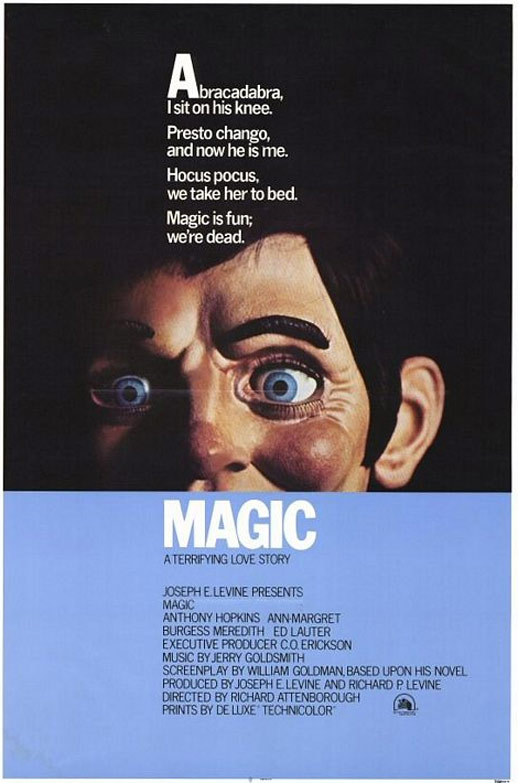
Magic


1978 was a great year for the horror film: Halloween, Dawn of the Dead, just to name a couple of the big hitters.

But the horror film from '78 I find myself returning to most often is Richard Attenborough's unhinged and certifiable Magic.

Magic was a big studio film directed by a very well regarded and established filmmaker who was better known for his acting gigs in movies like The Great Escape, Seance on a Wet Afternoon, The Flight of the Phoenix, among others.

Magic also starred Anthony Hopkins as ventriloquist Corky Withers who is controlled by his dummy Fats. Burgess Meredith plays Ben Greene, Corky's concerned manager, who tries to convince Corky to take some time away from Fats. Corky, however, needs to make a living and Fats is his money-maker. But, the truth is, Corky can't stop being Fats and Fats is actually Corky uncorked.

Fats does anything he can to keep Corky from making friends. He especially doesn't want Corky to fall in love, which he does anyway - to Peggy Ann Snow (Ann-Margret, you know, the infamous "Kitten with a Whip"). Peggy Ann is a threat to Fats but there's really not much she can do about Fats - er, Corky - anyway.

Attenborough and writer William Goldman (Butch Cassidy and the Sundance Kid) weave an intense, psychologically complex thriller that's unpredictable, perverse and creepy.

And the little ditty floating above Fats' head in the poster is marketing brilliance. It tells you everything and nothing:

Abracadabra,
I sit on his knee.

Presto chango,
and now he is me.

Hocus pocus,
We take her to bed.

Magic is fun;
We're dead.

Saturday, December 10, 2011

Hey Santa! Butt me!


This is going to be my last Christmas post for 2011. But you gotta hand it to Lucky Strike for their marketing cajones.

Does UPA's Frosty the Snowman = Creepy?

Okay, so I kinda Grinched myself when I recently tweeted that the clip below was "creepy."

But that doesn't mean its bad. Its jaunty, jazzy and of its time. It was produced in 1954 by UPA Studios and became a Chicago-area Christmas staple. Kids growing up during the 1960s and 1970s saw this thing a lot if they watched a morning show on WGN-TV called Ray Rayner and His Friends. Anyway, its a piece of nostalgic charm that's probably lost on anyone born after 1980.

Even if it is a little creepy...


Friday, December 9, 2011

Xmas


I find this film uninspired and the characters unappealing. But the poster has a way of embracing the season and I do appreciate that.

Plus I have a warm spot for this:


Wednesday, December 7, 2011

God Forgives...I Don't


One of my favorite lines in Robert Rodriguez's certifiably insane Machete is when Cheech Marin says, while pointing a gun at the head of a man begging for his life, "God has mercy...I don't."

A fantastically blasphemous statement punctuated by Marin pulling the trigger and blowing the man's brains out. What's better is that Marin plays a priest, so what he says, while not subtle, is hysterically offensive.

Machete began as a faux trailer in the Rodriguez/Tarantino film Grindhouse and Rodriguez developed it into a feature film that easily could have played second or third tier at some drive-in back in the 1970s.

What I recently learned was that the Marin statement actually spins off from an Italian film from 1967 called Dio Pardona...lo no! The American release was renamed Blood River, possibly because the distributors were nervous about the actual translation - God Forgives...I Don't!

The film stars Terence Hill who plays a character named Cat Stevens. Hill goes on to play this character in two other films: Ace High (1968) and Boot Hill (1969). These films also star Bud Spencer.

Terence Hill and Bud Spencer may not be known here in the States now but - believe it or not - in the early 1970s, they actually got some play and kids that hung out at Saturday or Sunday afternoon matinees during this time probably remember them.

Hill and Spencer paired up for a double shot of spaghetti western mayhem in My Name is Trinity (1970) and Trinity is STILL My Name (1971). My father took me to see both of them when I was really young. He must have liked My Name is Trinity because it wasn't long after seeing it that he hauled me to see the sequel.

I haven't seen either one since they came out but I do remember snippets. I remember Trinity riding into town, laying on a make-shift wooden sled pulled by his horse. Hill played Trinity so laid back that the character simply oozed charismatic obstinance. He was the perfect character for a generation trying to adopt a "What, me worry?" attitude despite the Vietnam War, campus violence, skyrocketing inflation, the gas crunch - all raging in life's background.

What's changed since then? Besides Vietnam, that is. The truth is we need Trinity now more than ever.


Friday, December 2, 2011

Pulp Fiction


"A book containing lurid subject matter, and being characteristically printed on rough, unfinished paper."

Vincent: I think we should be leaving now.

Jules: Yeah, that's probably a good idea.