Wednesday, November 24, 2010

HEADLINES

I don't read newspapers nearly enough. Used to read them everyday before I got an iPhone and hooked up to Twitter. Maybe not intellectually sound, but I use Twitter as my main source of news because its all the news that fits my agenda, whatever that may be (follow me and find out!).

I haven't really missed reading a newspaper but I'll give Chicago its due: two great papers, two awesome perspectives. I'll go on record and claim the Sun-Times as my favorite because of the caliber of its columnists.

The Tribune simply doesn't have that columnist cache (but, wow, that delicious 'frat boy' mentality that blankets an oh-so serious rag - ha ha, I was once accused of having 'pedestrian' tastes when an acquaintance caught me buying the Sun-Times at a local White Hen - just as the clerk was slipping it into a brown paper bag. I confirmed his belief when I said I could barely read above the third grade level and the Sun-Times was my "Dick and Jane" primer. His look was one of pity - no sense of humor, those Trib snobs).

Anyway, I read the papers mostly on days off - mainly the Sunday papers or an occasional holiday. Since I'm no longer an avid newspaper reader and since Twitter is based on (conceptually) headline writing (maximum 140 characters, you know the score), I've recently found that I love the wordsmithing of headlines and see them as a literary form (serious or campy) that have purpose.

The Sun-Times on this Wednesday, November 21, had some nice turns of phrase:
  • 'Game-changer' from Vatican on condoms
  • Man's body found in recycling bin
  • Suburban orthodontist charged with fondling teen
  • Sheen's $3,500 date doomed from the start (actually a Richard Roeper column)
  • Dog-dropping charges against woman dropped
  • 'That guy who is in charge is crazy': local Korean
  • Grey powers through pain for the win
  • Athletes' jersey numbers used as code for drug amounts
  • Found bone not Natalee Holloway's
  • In Four Loko ban, logic is left behind
These headlines flow with a sort of poetic timbre, roll easily off the tongue and - surprise - do their jobs. They make you want to read every one of the stories below them.

But I love these headlines, the Sun-Times vs. the Tribune, over (basically) the same story:
  • Sun-Times: Gov, Brady chew the fat at 'corned beef summit'
  • Tribune: With election decided, a delicatessen detente
Now, be honest, which story would you rather read?

I can tell what kind of person you are by your answer.

Monday, November 22, 2010

I HATE 'BUCKET LISTS'

"Bucket List" is a term copped from a really bad film released in 2007 that starred Jack Nicholson and Morgan Freeman. The term means doing all the things you want to do before you "kick the bucket." Its a glorified wish list that's designed to: 1) inspire you to live a more fulfilling life or 2) make you feel completely inadequate. I lean towards number two.

I was at a lunch when somebody asked everybody at the table to share one thing on their "bucket list." I cringed inside and hoped they wouldn't get to me...

Most everybody had some pretty simple wishes - visit all the baseball parks in the U.S., go to the Macy's Thanksgiving Day Parade in New York City, jump out of a plane, etc. When I heard these, I realized that I didn't have a "bucket list" at all - nothing grand or extravagant. I was embarrassed by my lack of wishes.

It seems to me that people who spout their "bucket list" wishes are doing a kind of intellectual showing off, trying to one-up their peers by the outrageousness of their lists. As if a crazy "bucket list" indicates some kind of creative superiority over everybody else.

They got to me and I flat out said I don't have a "bucket list." People feigned shock at my lack of response. But I couldn't just make something up - that wouldn't be true.

In the weeks since that lunch, I gave "bucket listing" a long hard think. And I came up with one bucket item.

And that's to stop going to lunches where people insist on sharing their "bucket lists."

Saturday, November 13, 2010

BOY WAS I SICK

I was out from Saturday through Wednesday last week with one of the worst bouts of flu I've ever experienced. Things got worse when it devolved into a major sinus/bronchial infection that now requires fist-sized antibiotic pills that I'll be on for two weeks. I was nearly comatose when I saw my doctor who readily wrote out the prescription when she laid eyes on me in my state of fever-induced delirium. She's not the type of doc who does this easily and needs deep reasoning for doling out drugs - and for this I'm grateful. The medicine kicked in quickly and I'm feeling quite normal now.

But I missed three days of work due to this illness - something that doesn't happen to me often. In fact, the most I've ever called in sick is once in the past six years. I don't ever use sick days to "play hookey." People who do that make me crazy.

I'm lucky. At my place of employment we get 15 days of vacation per year. We also get - I think - 8 sick/personal days (I think, because I don't use them) per year. That equals up to 23 days off. But for me, 15 vacation days are plenty and I usually don't burn all of them in a year. I tend to piggy back vacation days with holidays - time around the 4th of July, Thanksgiving, Christmas/New Year. I'm not being holier than thou here, its just my nature and I'm certainly not "kissing up" to the corporate machine.

Sick days are insurance. Use them up for personal pleasure and things can get haywire when you really do come down with something significant. Using sick days to play hookey will bite you back and hard. Now you're left having to force yourself into work when you really are sick (and, trust me, you will be and you will need sick days), selfishly spreading your germs to co-workers because you wanted your day in the sun.

Now I know there are times when you absolutely need to go into work when you're too sick to think. But when I see somebody suffering illness at work frequently, I have to wonder how many days they spent doing that "hookey" thing.

Wednesday, October 27, 2010

TO AIR GUITAR, DIVINE

How would you feel if you met someone who spent most of his or her time playing vintage video games like Donkey Kong or Pac Man? Would you tell this person to "get a life?" Would you automatically peg him or her as a "loser?"

Or what if you met someone who spent their time practicing air guitar rather than actually learning how to play the instrument for real? Another "loser," right?


But what if you realized these people are actually purpose-driven, committed individuals striving to be the best they can be within their chosen fields (master of Donkey Kong, best air guitarist in the world)?

You'd probably still find their obsessions weird but take a look at two documentaries that examine obsessed Donkey Kong and air guitar players - Seth Gordon's THE KING OF KONG: A FISTFUL OF QUARTERS and Alexandra Lipsitz's AIR GUITAR NATION - and you'll see people driven to succeed.

These documentaries aren't so much about the obsessions these people have, they're about unstoppable drive and commitment to achieve.

The challenge for most people is to get good at something. Some people are driven to be really good at something. And others simply need to be the best at this certain something and they'll push themselves to hit this pinnacle no matter what it is or how weird it may seem to the outside world.

Its not hard to figure out why people endlessly play video games. Its because you can keep score and the person with the highest score is deemed best. In THE KING OF KONG, player Steve Wiebe is driven to achieve a Donkey Kong score that will beat record-holder Billy Mitchell, who had previously achieved a Donkey Kong score of over a million in the 1980s. And, using his mathematical and engineering acumen combined with acute hand/eye coordination, Wiebe does it. Subsequently, he's ranked best (much to the consternation of Mitchell).

But what about air guitar? Air guitar's a whole different story. How do you judge best air guitarist? And what does an air guitarist need to do to be judged best? Can you be the best if you simply believe you are? Is it about total immersion into the song? Who doesn't air guitar at some point in his or her life? Am I the best because I can air shred to Yngwie Malmsteen or simply beat the air to Ramones punk chords? Judging air guitar becomes a totally subjective exercise.

Video games are objective. But scores can be marred by game-play error. Yet if I'm airing to Stevie Ray Vaughan's version of LITTLE WING and I miss a note - but I'm filled with the necessary passion - who's going to notice a missed note?

To quote the great Bjorn Turoque (aka Dan Crane) from the Lipsitz film, "To err is human; to air guitar, divine."

Turoque in AIR GUITAR NATION isn't just looking to be the best air guitarist, he's looking for divinity.

And what's better than that?

Sunday, October 10, 2010

DON'T PARTICIPATE IN SENSELESS DOLPHIN MURDER

In the documentary The Cove, directed by Louis Psihoyos, there's a scene where a panicked dolphin, who has already been slashed and speared, attempts to swim away from the wholesale slaughter of its family by psychotic Japanese fishermen. The dolphin struggles to get away as blood sprays from its wounded body until it finally bobs and rolls over giving way to violent death.

The slaughter of dolphins in Taiji, Japan, (official town website) is a daily affair. Thousands of dolphins are murdered in an area called the Cove, where the water turns crimson with blood every morning for no reason. The Japanese government sanctions the endless, senseless killing, where baby dolphins jump from the water in sheer terror as their families are beaten, stabbed and gored by boat hooks. The fishermen, who are diseased in mind and psychopathic, laugh as injured animals spray blood, drown and thrash for life.

Dolphins that survive are taken captive and shipped to waterparks and aquariums where they are imprisoned in tiny tanks and forced to either "swim" with people (who pay exorbitant rates to do this ridiculous act) or put on "shows" in water parks - like SeaWorld - around the world. (Don't buy into SeaWorld's platitudes about caring for the animals held prisoner at their parks. Conservation DOES NOT include holding animals captive in stressful situations. Orcas dying at SeaWorld are becoming commonplace...three senseless deaths in the past four months...)

The tanks at these parks are loud and small and dolphins, who - in their natural environment - typically swim upwards of 35 miles per day, are forced to swim in insanity-inducing circles while people scream and cheer at their tricks during expensive circus-like shows. The noise and lack of space causes unbelievable stress on these highly-intelligent animals, who often die as a result. Stress is also induced because these animals have witnessed the slaughter of their families and friends (dolphins are "pack" animals and highly dependent on one another for happy lives) and are now alone in tiny tanks, aquariums and parks.

Imagine being ripped from your family and friends (after seeing them slashed, stabbed and drowned) and put into a standing-room only cage that barely allows you to take a few steps during your waking hours. Imagine seeing your babies bludgeoned with baseball bats, stabbed with spears, throats slashed with knives.

So, I implore you:
  • DON'T participate in senseless slaughter and murder by visiting aquariums
  • DON'T support places like SeaWorld
  • DON'T participate in senseless slaughter and murder by "swimming" with dolphins
  • DON'T support any Japanese government initiatives until the practice of slaughtering dolphins (and other sea animals like whales and orcas) is deemed illegal
  • DON'T purchase Japanese vehicles (Toyota - are you listening?) until the practice of slaughtering dolphins (and other sea animals like whales and orcas) is deemed illegal
DO become enlightened. Watch The Cove. Follow on Twitter and Facebook.

And take action.

Wednesday, October 6, 2010

COLLECTING MOVIES

I collected movies on VHS but they took up too much room and were unbelievably inconvenient. Plus I hated watching movies in truncated versions, panned and scanned, cropped, etc.

DVD fixed that and in the early days of the format (the late 90s), movies became a revelation again. You were able to see them as intended, clear of vision. Plus they were cheap. I gobbled up the format and grabbed the movies that I hadn't seen correctly in years.


To see TAXI DRIVER the way Martin Scorsese filmed it, or to view the obscure David Cronenberg flick RABID in its wide screen format, was amazing. The movies that I thought I'd never see as intended made it into my living room: Peckinpah's oeuvre; Kubrick's masterworks; Italian crime films by Umberto Lenzi; the giallo of Dario Argento; the melodramas of Douglas Sirk and Nicholas Ray; the documentaries of the Maysles Brothers; David Lynch's madness; and way too many more to mention. Hundreds of them overflowing book shelves.

And now there's this crazy format called Blu-ray. Thanks Sony. I appreciate it.

Thanks a lot.

Sunday, October 3, 2010

THE MEDIUM ISN'T NECESSARILY THE MESSAGE

But the medium can throw users for a loop.

We're talking "social media" here and the fact that people may not understand that "social media" is the vehicle that carries the message. "Social networking" is the message you use to make connections with like-minded individuals who share common likes, dislikes, experience, etc.

But, by default, the message's medium does say something about the user and what he or she is trying to convey. Many people use LinkedIn, Facebook and Twitter simultaneously, tweaking their messages according to the medium and the user's audience. I'm certainly not going to brag about the rivers of beer I consumed over the weekend on my LinkedIn profile but I might on my Facebook (although I probably wouldn't there either because I don't consume rivers of beer anymore - now if I was in my early 20s, maybe - because my Facebook audience may share similar experience).

So the medium kind of designates your messaging...

The struggle for some people and companies embarking on social media usage is choosing the "correct" medium to let fly their messages. All I can say is that it depends on what you're trying to accomplish. And I'd also say that it wouldn't hurt to use multiple media.

Main thing - keep your profiles updated on all of your media. And let people know what you're doing. If you're posting information, let them know your active, that you're alive. Keep posting even if you get zero response.

And don't post anything that would embarrass your mother...especially if you're looking for a job. Know why? Prospective employers are checking you out whether you like it or not.

Wednesday, September 22, 2010

MISTAKES

We all make 'em.

But the problem - if you're the one who made the mistake - is that its hard to let go. Self-forgiveness is tough to come by.

Ironically, if the mistake somehow impacted somebody else, they'll probably forgive you quicker - if you cop to it right away.

So if you've made any mistakes lately, don't play the excuse card, don't play the blame game. You did it. So admit it. 

Sunday, September 19, 2010

IS JOAQUIN PHOENIX WORTH OUR TIME?

Remember Andy Kaufman? If you watched TV back in the 1970s and the early '80s, you probably do. He would show up on Saturday Night Live and do bizarre one-man skits, including the hilarious "Mighty Mouse" dub where he put a record on a turntable and stood in anticipation as the Mighty Mouse theme song played, punctuating the heroic lyrics with an extended hand. It was funny as hell. But what was really funny was that you couldn't make any sense out of it. And that was key to Kaufman's foolishness.


Kaufman then developed this "foreign" character named Latka and ended up on the sitcom "Taxi," as a lovable naif. At around the same time, Kaufman also developed this other character named Tony Clifton, who was an audience-abusing lounge singer. He was combative and cruel. Clifton even went after Kaufman, claiming that Kaufman was trying to ruin Clifton's "good name" for money and fame. Amazingly, people bought it and didn't know if Clifton was real or not. Some people didn't even realize Clifton was Kaufman.

Kaufman then insinuated himself into the wrestling circuit blasting the "sport" for its inauthenticity. He mocked professional wrestlers and made claims that anybody could do what they do, including himself. So he forced himself into the ring and eventually challenged women wrestlers in an over-the-top and aggressive manner.

Eventually he stepped into the ring with Jerry Lawler who supposedly "broke" Kaufman's neck using a move called the pile driver. For months after, Kaufman made appearances wearing a neck brace while threatening to take Lawler down while exposing him as a fake. Kaufman appeared on the David Letterman show in 1982 ranting about Lawler. Lawler himself showed up on the set and punched out Kaufman. Again, audiences were stunned into believing what they saw was the truth.

It wasn't true. Not one minute of it. It was brilliant and lengthy performance art.

Which brings us to Joaquin Phoenix and Casey Affleck. In the Affleck-directed documentary, I'M STILL HERE, Phoenix is shown as a drug-abusing, self-possessed, self-destructive, ego-maniac gone insane, turning his back on acting to pursue a career in rap music (seriously?). Phoenix actually told the press he was quitting acting and made an appearance on Letterman in February 2009 that was baffling (but not as incoherent as first reported) at best.


The I'M STILL HERE documentary was released in mid-September and reviewed by critics who weren't sure about its authenticity. Roger Ebert questioned it but also took it seriously as a film, hence the nature of his review. (See Ebert's follow-up here)

At the time of its release, Casey Affleck said I'M STILL HERE was 100% true. Phoenix said very little.

Two weeks later, Affleck revealed the documentary as a fake. Says Affleck in the New York Times, "I never intended to trick anybody. The idea of a quote hoax unquote, never entered my mind." Affleck then praised Phoenix for "the performance of his career."

The film, in very limited release, isn't gathering an audience because, frankly, most people don't care about the antics of two privileged Hollywood brats. The reporters and film reviewers who were duped are, more likely, simply embarrassed that they took the bait. These writers are crying foul and some are calling Affleck and Phoenix "knuckleheads" who have "a lot of explaining to do." (Patrick Goldstein, Los Angeles Times).

But why explain anything at all? And so what if Affleck and Phoenix are "knuckleheads?" They didn't hurt anybody. They made a stupid movie that wasn't really a documentary. They did something that Kaufman did some 30 years ago. (And, yes, Kaufman was a "genius," and Affleck and Phoenix are "knuckleheads" - big difference, blah, blah, blah...)

Goldstein makes the claim that Affleck "won't get to direct another movie any time soon." Really? Affleck's joke was that egregious?

All in all, this little antic was a diversion. A brief moment in time subverting the entertainment world's puffery and self-importance.

Here's to Affleck and Phoenix - a couple of "knuckleheads" exposing how stupidly unreal their own profession really is.

By the way, people are wondering if Letterman knew about the ruse when he had Phoenix on in February 2009. Turns out it was all part of the plan. Yes, Letterman knew.

Wednesday, September 15, 2010

LIGHTS OUT TONIGHT - DARKNESS ON THE EDGE OF TOWN

Life defining moments can come in simple packages found under a Christmas tree. For me, one such moment was exactly that - a Christmas present in 1980.

The present was Bruce Springsteen's 1978 album, "Darkness on the Edge of Town." By 1980, I was already a Springsteen fan and already had "Greetings from Asbury Park," "The Wild, the Innocent and the E Street Shuffle," and "Born to Run" in my collection. I also had "The River," which had been released in the Fall of '80. Until that Christmas morning, I didn't have "Darkness."


The album cover was stark and Springsteen, in white t-shirt and leather jacket, looks like he just woke up with a killer hangover. He actually looks like a burned out 50's holdover without the grease in his mussed up hair - a wasted throwback.

I remember dropping the needle on the record and "Badlands" exploding from my DLK speakers. I listened to the record all the way through over and over that day and through the night, shunning family on Christmas Day.

But I wasn't in the mood for holiday frivolity. My father had passed away two weeks before, John Lennon was murdered a week before that and my girlfriend at the time broke it off with me when she realized she couldn't take being with somebody in obvious mourning.

From the first line in "Badlands," I knew I was in the best hands possible at that time in my life: "Lights out tonight, trouble in the heartland."

It really was lights out for me at the age of 20. I didn't know what was happening in my life or how to deal with it. So "Darkness on the Edge of Town" was my refuge.

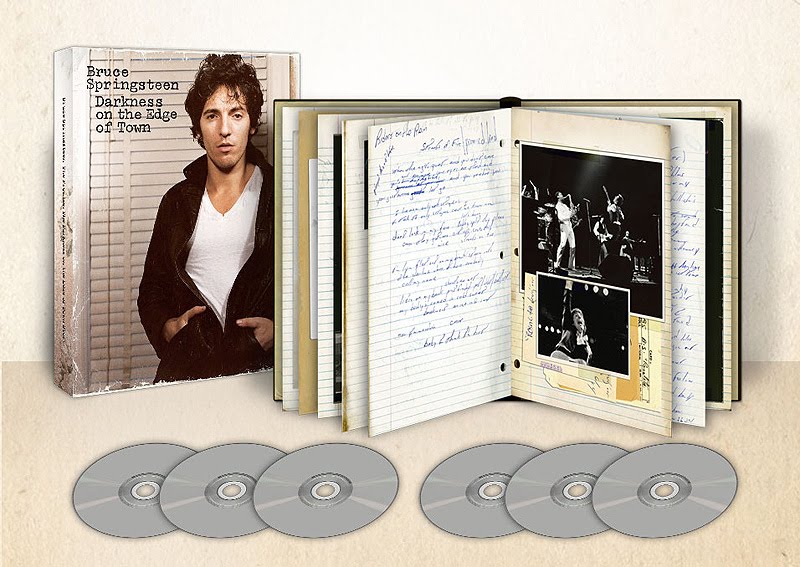
Now there's this massive box set called "The Promise: The Darkness on the Edge of Town Story," which includes the original album (digitally mastered for the first time), two additional CDs of music culled from that period and three DVDs (Blu-ray is available) of sessions and concerts during the making of and immediately after the release of this masterful record in 1978. It also includes an 80-page notebook with facsimiles of Springsteen's notes from the recording sessions, including lyrics, song ideas and recording details. 


This historical release can't possibly capture my time in 1980 but what it does is show an artist at the peak of his power not only as a lyricist but as a musician. Its the rare moment when you can enter an artist's creative process and this set is truly an open invitation.

Thursday, September 9, 2010

SOME FILM HISTORY: PAUL SCHRADER STYLE

If you're looking for film writing and its place in history, look no further than filmmaker Paul Schrader's amazingly rich website. At first glance you may think this is purely a vanity project (which - let's face it - it is) but its so much more.

The site delves into Schrader's writing and, specifically, Schrader's film criticism from the 1960s and 1970s. But what's really great is that you download the original articles scanned from their original sources ranging from the Calvin College Chimes and the Spectacle to the Los Angeles Free Press and Cinema Magazine to Film Quarterly and Film Comment.

Remember that Schrader has become a formidable and well-respected screenwriter and director in his own right. After all, this is the man who wrote TAXI DRIVER and directed such films as HARDCORE, AMERICAN GIGOLO, AFFLICTION, AUTO FOCUS.

His vision, in his criticism as well as in his films, is dark and astute (even though his book, TRANSCENDENTAL STYLE IN FILM: OZU, BRESSON, DREYER is almost impenetrable).

And you gotta love Schrader's own comment about his website:

"The following articles and reviews are listing chronologically and without comment. Some are youthful, some are wrongheaded, some are pretty good."

Go there: http://www.paulschrader.org/.

Sunday, September 5, 2010

THE WIND UP AND THE PITCH

When I was in college I sat behind a girl in a linguistics class who told me (for no apparent reason) that she was working on her "novel." This made me feel completely inadequate adding to an already rising stockpile of college-age inadequacies. A novel? Seriously?

I don't know if she ever wrote that novel. Maybe she did. Maybe she's written tons of novels since then. But she had something - at least at that time - I didn't. Conviction. And she was letting anybody know within earshot that she was doing this thing.

I was supremely unfocused during my college years. I was a writing major without an eye toward the future. Without a clue, I slogged through my classes and certainly didn't attach the title "novelist" to my name, let alone "writer" of any kind.

All these years later, buried under my official work title that bears the word "communications," is, indeed, that of "writer." A major part of my day is spent writing, whether writing for client web sites, newsletters, promotional materials, and numerous social media feeds (both on the client side and personal). I've also written magazine articles, technical articles, newspaper features and freelance film articles. I write this blog.

But I haven't written a novel. Or a full length book. So I decided it was time to make a pitch for a book that was not related directly to my job. I decided to pitch a film-based book to a publishing company called Pocket Essentials.

Why Pocket Essentials? Because they are open to ideas and their product is based on the writer's passion that's connected directly to the reader's passion. Whatever those passions may be.

Pocket Essentials submission guidelines include initially pitching your idea. And your idea should be based on marketing potential, audience potential, topic relevance, and "buy-ability."

They want your idea submitted as a proposal first. If they like your idea/proposal, they'll ask for a breakdown, which is basically how your book will layout chapter-wise.

I suppose this isn't any different from any other publishing house but Pocket Essentials seems particularly open to writers wanting and ready to leap to that "book" level.

I'm not going to give away my pitch here (at least not yet) but I went through the process like this:

  • I jotted pitch notes down on a piece of paper using the "clustering" method where I took one word and used that as an idea springboard.
  • I wrote my opening pitch line with the possible title of my book and defined it clearly.
  • I wrote a second paragraph stating the book's purpose, touching on possible chapter breakdown.
  • I focused on current relevance and "market-ability."
  • I closed with references to my background.
  • I cut anything that seemed extraneous and made sure the pitch was around 300 tightly constructed words.
  • With the pitch, I included previously published work. 

I followed Pocket Essentials' directions closely, which you should do when submitting ideas to any publishing house or company you'd like to do business with. Directions are there for a reason and they provide an ideal road map.

I bundled everything together and sent the pitch via e-mail, the Pocket Essentials preferred method of delivery.

The proposal is in Pocket Essentials' hands now. And, at this point, I've done just about all I can do.

Well...I guess there is one other thing I can do. And that's keep my fingers crossed.

Sunday, August 29, 2010

MOVIES - SUMMER 1977

Just for kicks, and since the end of summer looms, I decided to look back at some of the movies that played at local (Chicago-area) theaters during the summer of 1977, right before entering my senior year in high school.

Like today, many of the movies in '77 were horror shlock, sci-fi, melodramas and action. The biggest difference wasn't in the films themselves but where you watched them. Most of the movies you saw in 1977 were at stand-alone theaters as opposed to seeing them at massive strip mall cineplexes.

STAR WARS garnered the biggest box office dollars in 1977 and it played for the better part of the year rather than only at theaters for a short run like now where movies show for (at maximum) a couple months before hitting DVD.


In 1977, videotape players weren't on most consumers' radar (although consumer players were available at a very high premium). So, if you wanted to see a new movie, you had to go to the theater. You simply didn't have the "I'll just wait until it hits video" mindset.

During the summer of '77, much of my time was spent at the Skylark Drive-In Theater located off of Eola Road and New York Street in Aurora, IL. The Skylark is long gone and the grounds are now home to townhouses and strip malls.

This list (which is not definitive) includes movies that played at indoor theaters as well as double features that played at the Skylark or other drive-in theaters.

At indoor theaters in 1977:
  • WELCOME TO L.A.
  • THE LATE SHOW
  • MAN ON THE ROOF
  • STAR WARS
  • THE HOUSE BY THE LAKE
  • THE FARMER
  • IN THE REALM OF THE SENSES
  • THE LITTLE GIRL WHO LIVES DOWN THE LANE
  • THE WHITE BUFFALO
  • BAD
  • ANNIE HALL
  • CROSS OF IRON
  • SUSPIRIA
  • ONE ON ONE
  • BLACK AND WHITE IN COLOR
  • ALLEGRO
  • CAR WASH
  • ASSAULT ON PRECINCT 13
  • KID VENGEANCE
  • AIRPORT 77
  • SMOKEY AND THE BANDIT
  • THE SPY WHO LOVED ME
  • FIRE SALE
  • THE OTHER SIDE OF MIDNIGHT
  • THE LAST REMAKE OF BEAU GESTE
  • MARCH OR DIE
  • RAINBOW BRIDGE

At the Skylark (or other area drive-in theaters):
  • RUBY and THE BEAST MUST DIE
  • RUBY and THE LEGEND OF HELLHOUSE
  • RUBY and A BOY AND HIS DOG
  • THE CAR and TWO MINUTE WARNING
  • AUDREY ROSE and CARRIE
  • RABID and GOD TOLD ME TO
  • THE VAN and THE POM POM GIRLS
  • THE LITTLE GIRL WHO LIVED DOWN THE LANE and BREAKER! BREAKER!

Thursday, August 26, 2010

VINYL IS THE REAL DEAL...

"Vinyl is the real deal. I’ve always felt that until you buy the vinyl record, you just don’t own the album … It’s not just me, it’s not just a little pet thing, it’s not just some retro romantic thing from the past. It’s still alive." - Jack White

I saw White's quote on the WAX.FM blog and felt an emotional twinge and longing for the days when I'd spend hours in record stores browsing through rows and rows of vinyl. And then hours at home listening to them. 

WAX.FM is devoted to vinyl and explores the wonders of analog as opposed to digital recording and makes a strong case that music - rock music especially - is just plain better when listened to on record. WAX.FM has little regard for downloading songs or even listening to music on compact disc.

I'm not immune to downloading songs and I have a pretty healthy CD collection but WAX.FM is right - albums provide experience you just can't get by hitting the download button.

My vinyl experience began in 1975 with the purchase of my first record (which I still have) - Chicago's Greatest Hits. I had little musical guidance at that time and bought it because, as a kid, I loved the song 25 Or 6 To 4. Esoteric, tough to decipher, 25 Or 6 To 4 introduced me to the wonders of the guitar solo and its ability to burn unforgettably into your brain.

Five years later I started collecting harder edge garage and punk rock starting with the Clash London Calling, the Ramones Rocket to Russia, and didn't look back.


The vinyl experience started in the store, finding the record choice of the day, purchasing it and speeding home, going into my bedroom and firing up the stereo. At the peak of my obsessive vinyl days I had a Vector Research receiver, which pumped 150 watts per channel, waist-high DLK speakers, a Samsung graphic equalizer and a Harman/Kardon turntable.

I'd unwrap the album and carefully slide it from its sleeve, mindful to not touch the grooves, just the record's edges. I'd gently place the wax on the turntable, lift the table's tonearm and ease the cartridge onto the spinning black circle. I'd lower the turntable's dust cover, sit between the speakers and let the music roll over me, track by track until the first side was complete. Then I'd flip the record over and listen to side two non-stop.

If I loved the album, I'd repeat the process. If I wasn't immediately enamored, I'd put the disc away and return to it later that day or later that night, or after midnight, or after a crazy night of partying.

An album I loved could live in my consciousness for weeks and weeks, sometimes months (even years). I'd learn every pop between the grooves as if they were part of the music. I knew how long the blank intro groove would last before the first drum crack or guitar strum and I'd sit through the blank outro groove until the tonearm lifted on its own.


I became intimate with all of my records, made a deeply emotional connection as if they were living, breathing things. I amassed just over 1,000 records during my collecting years (throughout my 20s) and I still have them - albeit in storage.

Most are in mint condition and waiting for the day when I have the room to put them back on display. 

Sunday, August 22, 2010

HIPSTAMATIC iPHONE CAMERA APP = ART

Yes the iPhone camera has limitations but then again, most phone cameras do. However, what's great about them is that you can take photos on the fly when inspiration strikes.

I haven't gotten into the habit of carrying my regular camera with me all the time and, even if I did, to take good shots, you need set up time, etc. With your phone, you can pop pics right out of your car window and sometimes end up with photos that are pretty darn close to art. Okay, so you photogs out there are ready to scream at this statement regarding photographic art - but you're not using your phone camera for artistic expression anyway, right?

And the truth is (mostly), the pictures you snap with your phone aren't going to end up on display at MoMA any time soon but, believe it or not, you can snap some shots with your phone that are worth framing.

Especially if you find the right camera app that achieves a look you're going for. My favorite is called Hipstamatic, an amazing camera app complete with strange lens, film and flash options that give your pics real personality and an edge toward art.

Your initial Hipstamatic download (cost - $1.99) comes standard with three lenses:
  • The John S lens, which bathes your photos in oozing shadow
  • The Jimmy lens, giving your pics an old-timey, yellowy sheen
  • The Kaimal Mark II, producing slightly sleazy shots pulsating with a washed-out red hue
You can use different film types like the "Ina's 1969," which rocks light flares and deepens shadows. Or the "Kodot" choice, giving your photos a slightly unfocused appearance. The "Blanko" film type is smudgey and dirty.

My favorite lens is the Kaimal Mark II because of what it does to light and shadow. It also has a tendency to accent cloud cover and can make a slightly cloudy day foreboding.

Here's a bunch of shots I took with my iPhone using the Hipstamatic camera app. Most were taken from my car window, whether I was going mobile or sitting in an empty parking lot.


After storm shot with John S lens


Truck shot using Kaimal Mark II
Highway (I-88) shot with Kaimal -- note beautiful cloud capture
Glass building shot with Kaimal lens

River shot through Kaimal
House in Long Beach, IN - Kaimal lens
Calm before storm in cemetary - Kaimal lens
Kaimal lens makes this grave shot look like something out of a Juan Lopez Moctezuma film
Kaimal lens totally accents shadows and light
Kaimal lens gives impression of sweltering heat
Here's another Kaimal shot that accents cloud coverage